Christian Thielemann’s June 26th concert with Staatskspelle Berlin at Vienna’s venerable Musikverein almost felt like too much of a good thing. Works by two favourite composers, one possibly the twentieth century’s best vocal composer, and the other one of the finest late Romantic symphonic composers. The event took place in an exquisite, historic concert hall and was performed by a widely-acclaimed orchestra, helmed by one of the finest conductors.

Erin Morley with Staatskspelle Berlin conducted by Christian Thielemann. Photo: Amar Mehmedinovic
There was great beauty to the evening, but also some dissonance. As much as Richard Strauss’s songs are glorious, especially those set for orchestra, the songs chosen and the soprano featured, Erin Morley, were not particularly captivating. The coloratura voice may dazzle in bel canto opera, but rarely so Lieder, due to lack of warmth. Strauss created one of the glorious coloratura roles, Zerbinetta, in Ariadne auf Naxos, but in doing so he intended for her to contrast with the title character, a dramatic soprano, both musically and dramatically.
Of the selected songs, Amor, op.68/5 was the best executed, as it was written for coloratura. Moreover, in Lieder, much more than in opera, the capacity to communicate emotion by understanding and placing the correct emphasis on each word is paramount. This is something very few non-native speakers of German (Janet Baker, Jessye Norman, Thomas Hampson and Simon Keenlyside are exceptions that come to mind ) have ever achieved.
Despite a certain indifference to the first part of the concert, there was a revelation, the song Nacht, performed for the first time in the venue. This is not to be confused with Die Nacht, op.10/3 or An die Nacht, op.68, but rather, this particular Lied was posthumously orchestrated by German composer-conductor Thomas Hennig (born 1964). It is a beautiful song that also suited Morley’s high tessitura. It uses the same exquisite violin solo from Beim Schafengehen, the last of Strauss’s Four Last Songs. One hopes it will one day join Strauss’ regularly-performed repertoire, as it is certainly deserving.

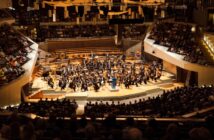
Christian Thielemann conducting Staatskspelle Berlin. Photo: Amar Mehmedinovic
The evening’s pièce de resistance was Bruckner’s masterwork. According to British composer Robert Simpson (1921-1997), Bruckner’s infrequently performed Sixth Symphony is considered the ugly duckling of the composer’s symphonic output due to its structural difference from the other ten.
Thielemann’s interpretation was spellbindingly magical, from the overwhelming timpani of the first movement (Maestoso) to the beautiful dialogue between trumpet and horn in the second movement (Adagio) and the achingly gorgeous entry of the oboe in the same movement. The precise dynamics in the third movement (Scherzo) are the true test in this work, and Thielemann’s equilibrium in that movement’s Trio was truly poetic. The boisterous conclusion (Finale) was monumental.
I would describe the audience reaction as euphoria mixed with sadness. The former, thanks to the masterful artistry of Thielemann and Staatskapelle Berlin, and the latter, as Thielemann, much-loved by the Viennese, will visit less frequently, now that he leads Staatsoper Unter den Linden and Staatskapelle Berlin. Fortunately, flights to the German capital are frequent and affordable.
More on Staatskapelle Berlin’s upcoming concerts and 25-26 season can be found here.