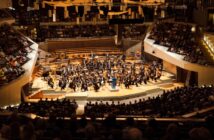
Roy Thomson Hall was filled from the main floor to the choir loft on May 7. The concert program features two mammoth works. The first, a contemporary premiere exploring artificial intelligence. The second, a treasure that highlights the everlasting capability of music to express emotional intelligence .
A pre-concert program offered in the lobby included Schubert’s Trout Quintet performed by members of the Toronto Symphony Youth Orchestra. The quintet is a challenging work. Kudos to the dedicated TSYO faculty coaches, performer members of the TSO who are also dedicated teachers: Shane Kim and Peter Seminovs (violin), Ivan Ivanovich (viola), Lucia Ticho (cello), Christopher Leven (double bass), Miles Haskins (woodwind), Nicholas Hartman (brass) and Joseph Kelly (percussion).
The TSYO performers themselves displayed a deep understanding of the function of the parts, keen observation of the contrasting dynamics and respect for the alternating tempi. The pianist expertly voiced the top notes of the chords.

TSYO pre-concert lobby performance. Photo: Allan Cabral/Courtesy of the Toronto Symphony Orchestra
The concert proper began with a stirring rendition of Oh Canada. The audience sprang to their feet, singing with passion as did the orchestra members. TSO Music Director Gustavo Gimeno then announced that a major gift had been received by the TSO to enable the commissioning of contemporary works. He then offered an insight into the strategy of programming without soloists: to feature the stellar capabilities of TSO orchestra members.
The first half of the evening’s program premiered Icelandic composer Daniel Bjarnason’s I Want to Be Alive—Trilogy for Orchestra (part of which was premiered by the TSO in 2021). The work is divided into three movements: Movement I: Echo (Man Needs Man), Movement II: Narcissus (We Need Mirrors) and Movement III: Pandora’s Box. An accomplished composer, Bjarnason has composed for orchestra, piano, and film.
The excellent program notes cite the composer: “While writing this work I wanted to think about how ancient archetypes resonate in the modern world. Especially when viewed through the lens of technological innovation such as artificial intelligence.” What better way to hear from the music sector on the impact of artificial intelligence than through the language of music?

Toronto Symphony Orchestra conducted by Gustavo Gimeno. Photo: Allan Cabral/Courtesy of the Toronto Symphony Orchestra
The work is electrifying. It poses musical questions to explore the complex interconnection of real and artificial intelligence. The first movement is laced with dialogue between sections of the orchestra, in quiet exploration. At one point the piano comes in with arpeggio like fragments that are tossed among the players. The strings alternate between warmth and lyricism on the one hand, and shimmering contrast when coupled with percussion and winds, creating the sensation of electronic music.
The second movement picks up the ethereal, shivering strings in contrast with low brass. The questioning began with the cello section with violas responding. Enter the woodwinds to create a sense of walking with nature, through a treasure hunt which again contrasted traditional and technological sound effects. The third movement is powerful without being bombastic. Winds imitate voices. The strings climb, the brass providing contrast with low strings and keyboard. The ending is foreshadowed by two notes, a powerful effect. Much to the delight of the audience, Conductor Gimeno—glistening with emotion—called the composer to the stage to receive multiple bravos.

Toronto Symphony Orchestra conducted by Gustavo Gimeno. Photo: Allan Cabral/Courtesy of the Toronto Symphony Orchestra
After intermission, Maestro Gimeno led the TSO in Tchaikovsky’s Symphony No. 6 in B Minor, Op. 74 (“Pathétique”). This was the composer’s sixth and final symphony, premiered shortly before his death It sparkles with tuneful, romantic suggestions reminiscent of his other works, including The Nutcracker. The orchestra brilliantly traversed its gamut of emotions, from angst to serenity, with precision. The audience responded with bravos, foot stomping, and calls for more.
On the subway ride home connecting Roy Thomson Hall with the greater Toronto suburbs, TSO fans could be spotted in animated conversation, holding their concert programs within a sea of jubilant Toronto Maple Leafs fans in their blue sweatshirts. A memorable night for Torontonians to celebrate and cherish.
Toronto Symphony Orchestra repeats this program on Saturday, May 10. www.tso.ca